Most small businesses don’t have a marketing problem.
They have a perception problem.
A customer can compare ten businesses in less than five minutes.
- Most offer similar products.
- Similar prices.
- Similar promises.
The business that feels more trustworthy usually wins.
- That’s branding.
- Not advertising.
- Not social media.
- Not a logo.
Branding is the reason someone chooses you before they fully understand what you sell.
For a small business, that first impression matters more than ever.
You rarely get a second chance to explain yourself.
Good branding isn’t about looking expensive
It’s about looking intentional.
- Customers notice the small things.
- A confusing logo.
- Different colours across platforms.
- Packaging that feels generic.
- A website that doesn’t match the product.
None of these seem like major problems on their own.
Together, they create doubt.
People may never say it out loud, but they ask themselves one question.
“If the business doesn’t pay attention to its own brand, will it pay attention to me?”
Trust begins long before someone becomes a customer.
Why small businesses need a clear brand identity
Large companies have something most small businesses don’t.
Recognition. People already know them.
Small businesses have to earn that trust from scratch.
- That’s why brand identity matters.
- A clear identity helps people remember you.
- It gives consistency to every interaction.
It makes marketing easier because customers recognise your business before reading a single sentence.
Brand identity isn’t decoration.
It’s a business asset.
What is brand identity?
Most people think it’s a logo.
A logo is simply the symbol.
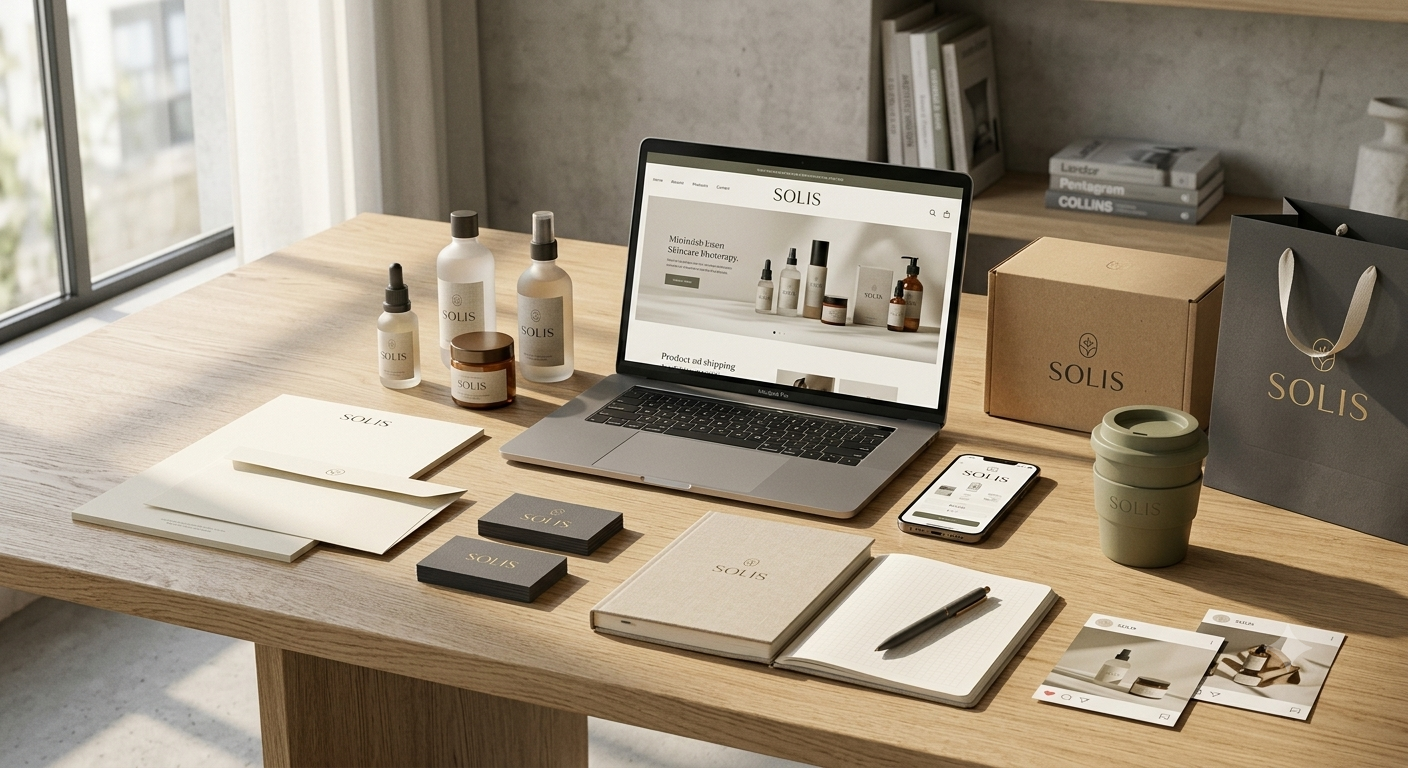
Brand identity is everything that surrounds it.
It includes:
- Visual identity
- Logo system
- Typography
- Colour palette
- Packaging
- Photography style
- Brand voice
- Website appearance
- Social media presence
- Printed materials
When all these elements work together, customers stop seeing individual designs.
They begin recognising the business.
Every decision shapes perception
Customers don’t separate your website from your packaging.
- Or your logo from your invoices.
- They experience everything together.
- That’s why consistency matters.
When every touchpoint feels connected, people begin trusting the brand without thinking about it.
Consistency removes hesitation.
And hesitation is expensive.
Our approach to branding
Every business already has a story.
Sometimes it simply hasn’t been expressed clearly.
Before opening design software, we ask questions.
- Who are your customers?
- Why do they choose you?
- What do competitors all look like?
- What should people remember after seeing your brand for five seconds?
Those answers become the foundation.
Design simply makes that thinking visible.
We don’t chase design trends
- Trends change.
- Businesses don’t.
- Minimalism was popular.
- Then gradients returned.
- Now bold typography is everywhere.
- Five years from now something else will replace it.
Your brand shouldn’t need redesigning every time design trends change.
We create identities that still feel relevant years later because they’re built around your business, not today’s visual fashion.
Brand identity for every stage of business
Every small business reaches a point where branding becomes necessary.
- Sometimes you’re launching.
- Sometimes you’re growing.
- Sometimes you’ve simply outgrown your current identity.
- We work with businesses at every stage.
Whether you’re opening your first café, launching a D2C product, expanding a manufacturing company, building a consultancy, or modernising a family business, the goal remains the same.
Help people remember you.
Industries we work with
No two industries communicate the same way.
A healthcare company builds confidence differently from a clothing label.
A restaurant creates emotion differently from a construction company.
We’ve worked with businesses across:
- Food and Beverage
- Fashion
- FMCG
- Retail
- Manufacturing
- Hospitality
- Healthcare
- Beauty
- Construction
- Technology
- Professional Services
- Consumer Products
Different industries. One principle.
Good branding makes trust easier.
What small businesses gain from strong branding
Branding doesn’t magically increase sales overnight.
It changes how people perceive your business.
That perception influences every buying decision that follows.
Businesses with a clear identity often experience:
- Better customer recall
- Stronger referrals
- Easier product launches
- More consistent marketing
- Higher perceived value
- Greater customer confidence
- Better recognition across digital and physical channels
People don’t always buy the cheapest product.
They often buy the one they trust first.
Australian and global branding trends
Small businesses are competing in a different world today.
- Customers discover brands on Instagram.
- Compare them on Google.
- Read reviews.
- Visit the website.
- Watch short videos.
- Then decide.
Brand identity now has to work across every platform.
Some of the strongest branding trends influencing businesses include:
- Simpler visual systems
- Sustainable packaging
- Authentic photography
- Human-centred storytelling
- Flexible logo systems
- Minimal colour palettes
- Clear typography
- Consistent digital experiences
Technology changes.
Trust doesn’t.
Original insight from our work
- One lesson keeps repeating itself.
- Businesses rarely need more design.
- They need better decisions.
- A logo cannot solve unclear positioning.
- Packaging cannot fix confusing messaging.
- A beautiful website cannot replace trust.
- The strongest brands are built when strategy comes first.
- Design simply gives it a face.
Professional branding vs DIY branding
Professional Brand Identity |
DIY Branding |
| Built around business goals | Built around available templates |
| Consistent across every touchpoint | Different styles across platforms |
| Memorable visual language | Generic appearance |
| Supports long-term growth | Often requires frequent redesign |
| Builds customer confidence | Creates mixed impressions |
| Flexible for future expansion | Difficult to scale |
Small businesses don’t need the biggest budget.
They need clarity.
Why branding matters more than ever
- Customers have endless choices.
- Attention spans are shorter.
- Competition is increasing.
- The businesses that stand out aren’t always the biggest.
- They’re the easiest to remember.
- Good branding creates familiarity.
- Familiarity creates trust.
- Trust creates business.
That’s why branding isn’t a luxury for small businesses anymore.
It’s one of the smartest investments they can make.
Brand identity in numbers
Research across global markets continues to show that consistent branding contributes to stronger customer recognition and purchase confidence. Consumers often form an impression of a business within seconds of seeing its visual identity, and those first impressions influence whether they continue exploring or move on to a competitor.
For small businesses, every interaction matters. A consistent logo, clear messaging, professional packaging, and a well-designed website work together to create familiarity. Over time, that familiarity becomes one of the most valuable competitive advantages a growing business can build.
Case Studies
Every branding project teaches us something.
Not about design.
About people.
Customers don’t remember every colour or font.
They remember how a brand made them feel.
These three projects show how different businesses faced different challenges, yet the solution always began with the same question.
How should people remember this brand?
Case Study 1
B.L.F Liza Dresses
The Challenge
Fashion is crowded.
Customers scroll past hundreds of clothing brands every day. Many offer similar styles, similar prices, and similar promises.
The challenge wasn’t simply creating another logo.
It was creating an identity that felt modern enough for today’s audience while giving the brand enough personality to be remembered.
A fashion brand lives in people’s minds long before it reaches their wardrobe.
That first impression mattered.
Our Thinking
Instead of chasing seasonal fashion trends, we focused on building a timeless visual identity.
The goal wasn’t to make the brand louder.
It was to make it clearer.
Every visual element needed to reflect confidence, elegance, and simplicity.
Fashion changes every season.
A brand shouldn’t.
The Solution
We developed a refined visual identity that balanced contemporary styling with long-term recognition.
Typography, colour selection, and the overall identity were designed to create consistency across retail, social media, packaging, and digital platforms.
Rather than competing for attention, the identity encourages people to pause.
The Result
The brand now feels cohesive.
Customers experience the same personality whether they discover the business online or interact with its products.
That’s what good branding should do.
It removes uncertainty.
Case Study 2
Raju Da Enterprises
The Challenge
Family-owned businesses often build strong reputations over many years.
The challenge is modernising the brand without losing the trust already attached to the name.
People recognised the business.
The identity simply hadn’t kept pace with its reputation.
Our Thinking
We avoided changing the brand for the sake of change.
Instead, we focused on preserving familiarity while improving clarity.
Customers shouldn’t feel they’re looking at a different business.
They should feel the same business has grown.
The Solution
The identity became cleaner, stronger, and easier to recognise across every application.
The visual language was simplified while maintaining the heritage behind the brand.
Every element was designed to communicate reliability.
Not trends.
The Result
The refreshed identity better reflects the professionalism customers already associate with the business.
It’s a reminder that rebranding isn’t always about becoming someone new.
Sometimes it’s about becoming more recognisable.
Case Study 3
Anupam’s Namkeen
The Challenge
Walk into any supermarket.
You’ll see hundreds of snack products competing for attention.
Customers don’t compare every ingredient.
They notice the packaging first.
For Anupam’s Namkeen, the challenge was creating packaging that immediately communicated authenticity, freshness, and quality while standing confidently beside established brands.
Our Thinking
Packaging isn’t decoration.
It’s silent communication.
The right colour can suggest flavour.
Typography can suggest quality.
Layout influences trust.
Every design decision needed to make the product feel familiar without looking ordinary.
The Solution
We created a packaging identity that balances tradition with a modern retail presence.
Bold colours improve shelf visibility.
Clear information improves readability.
Consistent branding strengthens recognition across multiple product variants.
The packaging now works as both protection and marketing.
The Result
The product has a clearer identity that reflects the quality inside the pack.
Instead of blending into the shelf, it gives customers a reason to stop and look.
That’s often the first step towards purchase.
What These Projects Have In Common
- Different industries.
- Different audiences.
- Different products.
- The same principle.
Every successful project began by understanding the business before designing for it.
That’s the difference between branding and decoration.
Decoration makes things look better.
Branding helps people remember.
Is It Time To Rethink Your Brand?
Many small businesses wait too long.
Not because they don’t believe in branding.
Because they think they’ll do it later.
Later often becomes years.
Meanwhile, marketing becomes inconsistent.
New products look disconnected.
The website feels different from the packaging.
Customers become confused.
If any of these sound familiar, it may be time to rethink your identity.
- Your logo no longer reflects your business.
- Different marketing materials look unrelated.
- Customers don’t remember your brand.
- Your competitors appear more established.
- You’re entering new markets.
- You’re launching new products.
- Your business has grown, but your identity hasn’t.
Branding isn’t about starting again.
It’s about moving forward with clarity.
A Simple Brand Identity Checklist
Ask yourself five questions.
- Can someone recognise your brand without reading your name?
- Does your website feel like your packaging?
- Would your social media still feel familiar without your logo?
- Can every team member describe your brand in the same way?
- Does your business look as professional as the service you provide?
If the answer is “no” to several of these questions, the issue usually isn’t marketing.
It’s branding.
Frequently Asked Questions
Is brand identity only for new businesses?
No.
Some of the strongest branding projects begin after a business has been operating for years.
Growth often creates the need for a clearer identity.
How long does a branding project take?
Every project is different.
The timeline depends on research, strategy, revisions, and the number of brand assets involved.
Good branding shouldn’t be rushed.
Can you redesign an existing brand?
Yes.
Many businesses don’t need a completely new identity.
They need a thoughtful evolution that keeps customer trust while improving perception.
Do you create packaging and websites too?
Yes.
A brand should feel consistent everywhere.
Packaging, websites, presentations, social media, and printed materials all contribute to how customers perceive a business.