
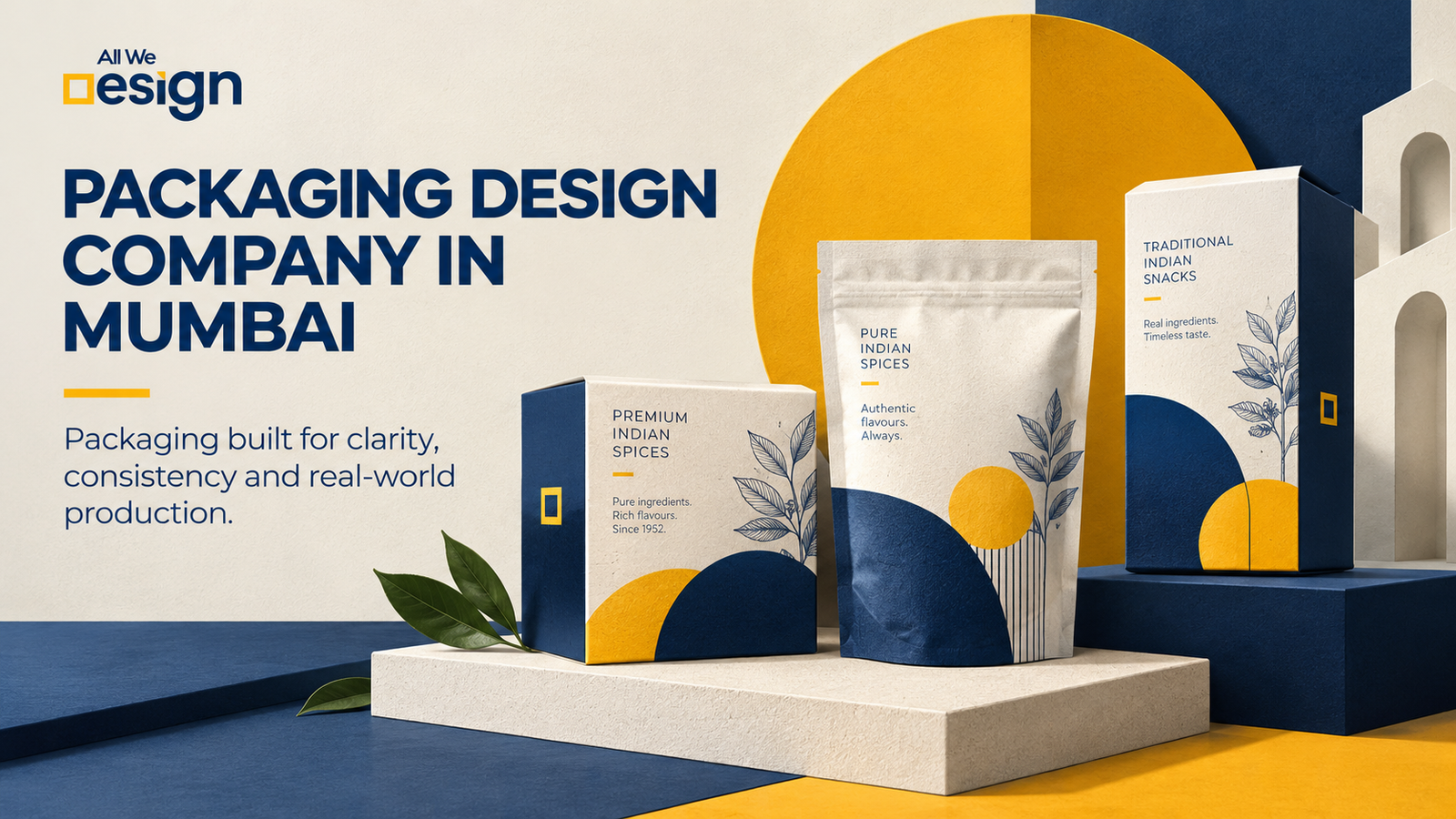
Packaging decisions become more complicated as a business grows. One product becomes five. A label that worked for a small batch needs to work across larger print runs. A design created for a shop shelf must also look clear in an online listing. And every improvement has to make sense within the production budget.
These are practical challenges, not just creative ones. Packaging needs to represent the brand, protect the product and work within the realities of manufacturing.
For businesses looking for a Packaging Design Company Mumbai, the right starting point is not a colour palette or a mock-up. It is understanding what the packaging needs to do, how it will be produced and where customers will encounter it.
All We Design is a Kolkata-based branding studio that works remotely with businesses across India. Our approach brings brand strategy and packaging design together, with attention to visual consistency, production requirements and the experience customers have with the finished product.
Packaging Must Work Beyond the First Product
A design can look excellent on one pack and become difficult to manage when the range expands. A business might begin with a single spice blend, snack flavour or product size, then introduce several variations over the next year.
If each new product is designed independently, the range can quickly lose consistency. Logos move, typography changes, colours become disconnected and customers have to work harder to recognise the same brand.
A packaging system solves this by establishing rules before individual designs are produced. The brand name, typography, layout and key visual elements remain consistent, while colours, product names and other details distinguish one variant from another.
This matters commercially because repeat customers should be able to recognise a familiar product quickly. Retailers also benefit from a range that looks organised rather than assembled from unrelated designs.
Before design begins, it helps to map the likely product range. Even if only two products are launching today, the packaging should leave room for future sizes, flavours and formats.
Cost Conscious Design Starts Before Printing
Packaging budgets involve more than the cost of designing a label. Material choice, printing method, finishing, production quantity, wastage and supplier requirements can all influence the final expense.
A design that relies on several special finishes may look impressive in a presentation but become impractical at the required production volume. Similarly, an elaborate structure may add cost without providing meaningful protection or improving the customer experience.
The answer is not always to choose the cheapest option. It is to identify which details contribute real value and where a simpler solution would perform just as well.
A practical packaging brief should consider:
- The expected initial and repeat order quantities.
- The available packaging formats and materials.
- The number of colours and print processes supported by the supplier.
- Whether special finishes are necessary for the product’s positioning.
- The cost implications of adding future variants.
- The need for separate artwork versions, labels or language requirements.
Designers should work with the business and its packaging manufacturer to understand these constraints early. Print-ready artwork must follow the printer’s specifications, including dimensions, bleed, safe areas, colour requirements and dielines where applicable.
The most useful design is not the one with the most effects. It is the one that communicates the product clearly and can be reproduced reliably.
Material and Printing Limitations Should Shape the Design
Packaging is produced through physical processes, and those processes influence how artwork appears in the real world. Colours may look different across materials. Small text can become difficult to read. Fine lines and detailed illustrations may not reproduce as intended on every substrate or printing method.
Flexible pouches, paper labels, cartons, jars and rigid containers each bring different design considerations. The available surface area, curves, seams, folds and viewing angles can affect layout and legibility.
This is why packaging should not be approved only from a flat digital image. A visual mock-up helps communicate the concept, but a printer’s technical specifications and, where appropriate, a physical proof or sample are important before full production.
The design process should account for:
- Minimum readable type sizes for the chosen format.
- Clear space around important product information.
- Contrast that remains effective on the actual material.
- The placement of seams, folds, closures and labels.
- Consistency between the approved artwork and the printed output.
These checks help reduce avoidable revisions and make the final packaging more dependable. They also keep creative decisions connected to the way the product will actually be manufactured.
Retail Packaging and E Commerce Packaging Have Different Jobs
A package displayed on a retail shelf competes with neighbouring products. It needs a recognisable brand name, a clear product description and a visual hierarchy that helps shoppers understand the offer quickly.
Online, the same package may first appear as a small product image on a phone screen. Details that are visible in a large photograph may disappear in a marketplace thumbnail. A design can look attractive at full size and still become difficult to identify when reduced.
Packaging should therefore be considered alongside the product’s sales channels.
For retail, the priorities may include quick recognition, clear product differentiation and a strong relationship between the brand and its variants. For e-commerce, the packaging should also photograph well, communicate the product clearly at reduced sizes and support consistent imagery across product listings.
Some products require different packaging formats for different stages of the journey. A display carton may support presentation, while the primary pack must meet the product’s protection and handling requirements. For shipping, additional outer packaging may be needed to reduce damage in transit.
Visual design alone cannot determine whether a package is suitable for shipping or storage. Product testing and advice from the relevant manufacturer or technical professional are important where protection, shelf life or transport conditions are involved.
Indian Packaging Regulations Need Early Attention
Regulatory requirements should be considered during the packaging brief, not left until artwork is ready for printing. The information required depends on the product category, the materials used, the way the product is sold and the rules applicable to the business.
For example, India’s plastic packaging framework includes Extended Producer Responsibility requirements. The Government of India’s Press Information Bureau explanation of the EPR guidelines for plastic packaging describes obligations introduced under the Plastic Waste Management Amendment Rules, 2022, including targets relating to recycling, reuse of rigid plastic packaging and recycled plastic content.
The implications for an individual business depend on its role, packaging type and applicable rules. Businesses should check current requirements with the relevant authorities and qualified compliance professionals rather than relying on a design agency to determine their legal obligations.
Food packaging may also require category-specific checks, including applicable labelling and food safety requirements. Product claims, declarations, ingredient information, dates and other mandatory details should be verified by the responsible business and its compliance advisers before production.
The designer’s role is to create a clear, usable layout that accommodates the approved information. The final artwork should then be checked against the applicable requirements. A well-designed package does not, by itself, guarantee regulatory compliance.
Sustainability Requires More Than a Green Colour Palette
Sustainable packaging is not a visual style. A kraft-paper appearance or a recycling symbol does not automatically make a package environmentally responsible.
The actual impact depends on factors such as the product’s protection needs, material composition, amount of material used, transport, local collection and recycling systems, and the way the packaging is disposed of. A material that appears environmentally preferable may not be suitable for every product or available through every local waste-management system.
A more useful design conversation starts with specific questions. Can the package use less material without compromising protection? Is the chosen material compatible with the product? Are recycling or disposal claims accurate for the relevant market? Can the packaging supplier substantiate the material specifications?
Businesses should confirm these details with manufacturers and appropriate technical or compliance professionals. Any environmental claims on the package should be accurate, specific and supportable.
Design can help communicate verified information clearly. It cannot make unsupported sustainability claims true.
Packaging Case Studies From All We Design
Every product brings its own commercial problem. The purpose of packaging design is to respond to that problem through clear visual decisions, rather than applying the same style to every category.
The following projects illustrate different packaging considerations across food, consumer products and premium product presentation.
Anupam’s Namkeen Snacks
The packaging challenge
Snack products often compete with other brands offering familiar flavours and similar product formats. The packaging needs to help customers recognise the brand, understand the product and distinguish between items in the range.
The design consideration
For Anupam’s Namkeen, the packaging work brings attention to product recognition and a consistent visual identity. A connected design system helps the brand maintain familiarity while making individual products easier to identify.
This is especially important when a range contains multiple snack varieties. Each pack needs enough distinction to communicate its contents without losing its relationship with the wider brand.
Why it matters
Packaging must do more than look attractive in isolation. It should help the range feel organised and make the brand recognisable across repeated customer interactions.
View the Anupam’s Namkeen Snacks project.
Bhimsaria Masale
The packaging challenge
Spice packaging must balance product identification with a sense of authenticity. Customers need to identify the brand and the particular spice without navigating a cluttered layout. At the same time, the packaging should feel appropriate to the product category.
The design consideration
The packaging direction for Bhimsaria Masale focuses on presenting the range as a connected family. Clear hierarchy helps the brand name and product information work together, while a consistent visual approach supports recognition across products.
For a category with multiple individual spices and blends, that balance is important. The range needs a shared identity, but the contents of each pack must remain easy to distinguish.
Why it matters
A packaging system gives a business a more practical foundation for future products. Rather than starting from scratch with each new item, the brand can extend its visual language while retaining a recognisable structure.
View the Bhimsaria Spices project.
Madhupati Makhana
The packaging challenge
A packaged snack needs to communicate what it is quickly while giving customers a reason to consider it. As the range develops, the visual system must also accommodate product variations without making the packs look unrelated.
The design consideration
The Madhupati Makhana project provides another food-packaging reference. The useful design question for a product in this category is how to balance brand visibility with clear product communication, so the customer can identify both the brand and the product without unnecessary visual competition.
For growing ranges, the same principle should guide the treatment of different variants, pack sizes and product information.
Why it matters
A clear packaging structure can support consistency across a product range and make future extensions easier to manage. The final format and materials still need to be chosen around the product’s physical requirements and production process.
View the Madhupati Makhana project.
Sarfa Gold
The packaging challenge
Packaging for a product positioned around quality needs to communicate value without overwhelming the customer with competing visual elements. Too many decorative details can make a design difficult to read, while a poorly organised layout can weaken the intended impression.
The design consideration
The Sarfa Gold packaging project offers a reference for how visual hierarchy, colour, typography and spacing can work together to establish a more deliberate presentation. The aim is to make the design feel considered while keeping the product and brand communication clear.
The broader lesson is that a premium impression does not always require elaborate finishes. The design should first establish what the customer needs to notice and then use visual details to support that priority.
Why it matters
Packaging should reflect the product’s positioning and the expectations of its intended audience. Production choices should then be assessed with the manufacturer to ensure the intended appearance can be achieved within the available budget.
Choosing the Right Packaging Design Partner
A packaging partner should be able to discuss more than visual style. Before appointing a designer, businesses should understand how the team approaches the product range, prepares artwork and works with production constraints.
Ask to see relevant packaging examples, especially work involving products similar to yours. Discuss the number of variants, the formats required, the intended sales channels and the information that must appear on each pack.
It is also worth clarifying what the final delivery includes. Does the scope cover packaging concepts, variant development, mock-ups, print-ready artwork and revisions? Who will confirm the technical specifications with the printer? Who is responsible for checking mandatory product information?
These questions make expectations clearer and reduce the chance of discovering important gaps late in the process.
All We Design works remotely with businesses across India. Projects begin with understanding the product, audience, market position and practical requirements. That foundation helps guide the creative direction and keeps the packaging decisions connected to the business rather than to a passing design trend.
Planning a Packaging Launch or Refresh?
Good packaging starts with understanding the product, the customer and the market it needs to compete in.
All We Design works remotely with businesses across India to develop packaging that communicates clearly, supports brand recognition and considers real production requirements.
Tell us about your product, target audience and packaging goals.
Frequently Asked Questions
1. What should I prepare before starting a packaging design project?
Prepare your product details, target audience, sales channels, existing brand assets, packaging dimensions if available, expected quantities and any mandatory product information. If a manufacturer has already been selected, request their artwork specifications before design begins.
2. How much does packaging design cost?
The cost depends on the number of products and variants, the complexity of the design, the packaging formats and the scope of work. Print production, materials, testing and manufacturing are separate considerations. A clear brief helps establish a realistic project estimate.
3. Can one packaging design system cover multiple products?
Yes. A packaging system can keep the logo, typography and key visual elements consistent while using specific colours, names or other identifiers to distinguish products. This makes it easier to extend the range without designing every pack independently.
4. Can packaging be designed for both retail and e-commerce?
Yes. The design can be developed with both environments in mind. Retail packaging needs clear shelf recognition, while online product images need to remain legible at smaller sizes. Shipping protection and packaging suitability should be assessed separately with the relevant supplier.
5. Does All We Design work with businesses in Mumbai?
Yes. All We Design is based in Kolkata and works remotely with businesses across India, including businesses seeking packaging design support for products sold in Mumbai and other markets.
6. Can packaging design help control production costs?
Design can help businesses make more informed choices about layout, finishes, variants and artwork complexity. However, final costs depend on materials, quantities, printing methods and manufacturer pricing. These details should be discussed with the production supplier before approval.
7. Who checks packaging regulations and mandatory product information?
The business placing the product on the market is responsible for ensuring that applicable requirements are met. The design team can organise the approved information within the layout, but the business should confirm the content and compliance with qualified professionals and relevant authorities.
8. Does sustainable-looking packaging mean the product is environmentally friendly?
No. Colour, appearance and symbols do not establish environmental performance. Material suitability, product protection, disposal infrastructure and substantiated claims all matter. Businesses should verify material and environmental claims with appropriate suppliers and advisers.
9. What do I receive at the end of a packaging design project?
Deliverables depend on the agreed scope and may include approved packaging artwork, product variants, mock-ups and print-ready files prepared to the manufacturer’s specifications. Confirm the exact formats, revision rounds and production responsibilities before the project begins.
Planning a Packaging Launch or Refresh?
Good packaging starts with understanding the product, the customer and the market it needs to compete in.
All We Design works remotely with businesses across India to develop packaging that communicates clearly, supports brand recognition and considers real production requirements.
Tell us about your product, target audience and packaging goals.