
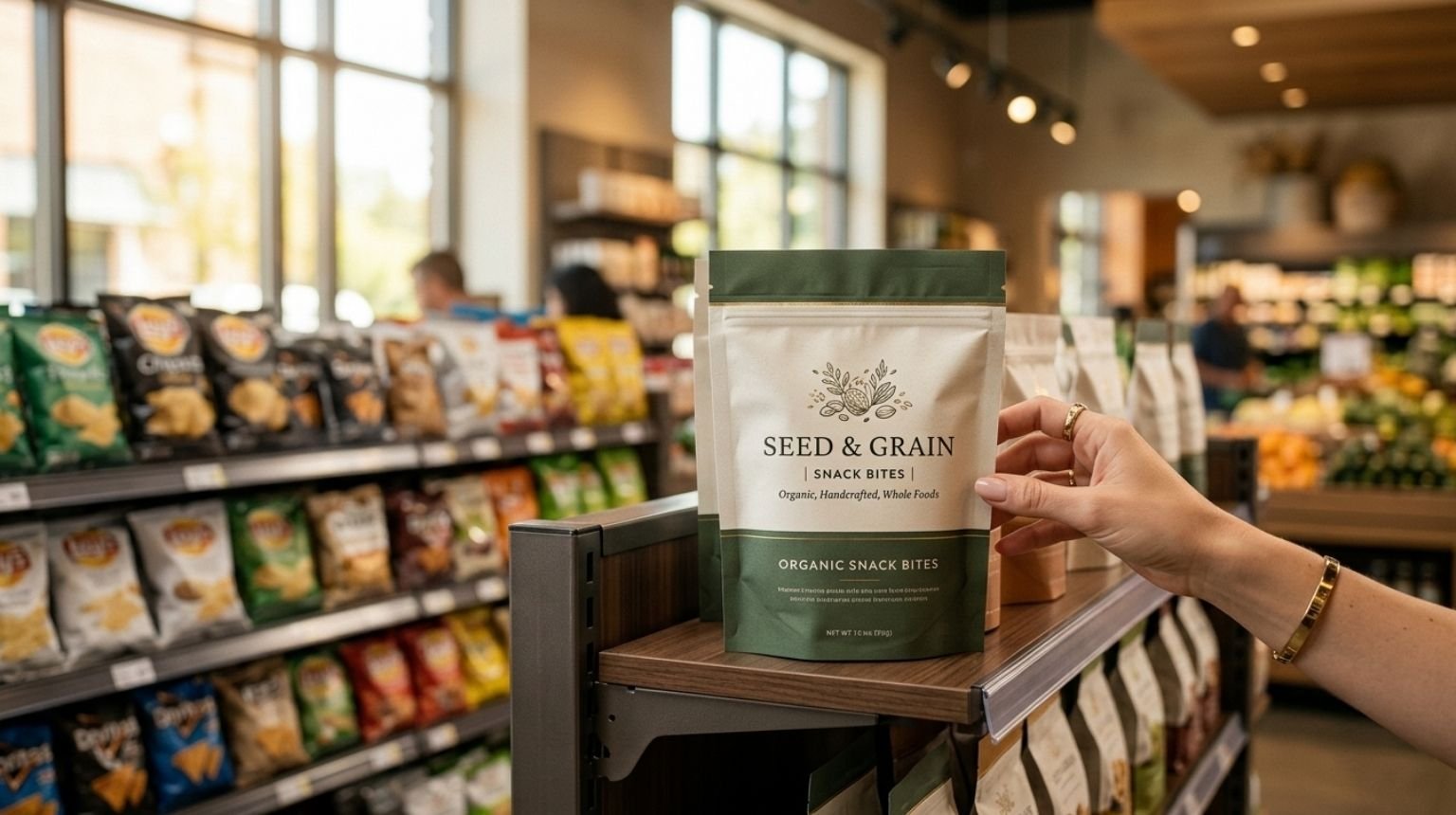
The product isn’t the first thing people buy.
The packaging is.
Walk into any supermarket. Or scroll through an online grocery store.
Customers don’t taste the food first.
They don’t read the ingredients. They don’t know your story.
They see a package. Then they make a decision.
For food startups, that moment matters more than most founders realise.
Great products fail every year. Not because the recipe was wrong. Because nobody picked them up.
Packaging isn’t simply a wrapper. It’s your first conversation with a customer.
Good packaging creates confidence before the first bite
Most founders spend months perfecting their product.
- The recipe.
- The ingredients.
- The sourcing.
- The manufacturing.
- Then packaging becomes the final task before launch.
We’ve learned that it should happen much earlier.
Because packaging influences everything that follows.
- Shelf visibility.
- Brand recognition.
- Perceived quality.
- Customer trust.
- Even pricing.
People naturally expect more from products that look considered.
Not expensive. Intentional.
That’s an important difference.
Food startups compete long before customers compare products
A supermarket shelf isn’t organised by quality. It’s organised by attention.
Your product sits beside brands that have spent years building recognition. Some customers already know those names.
You have only a few seconds to earn curiosity. Packaging helps close that gap.
It doesn’t pretend your startup is a household name. It simply gives customers a reason to notice. And that’s where every successful food brand begins.
Packaging is branding people can hold
A logo lives on a screen. Packaging lives in people’s hands. Customers touch it. Carry it home. Place it on their kitchen shelf. See it every day.
Few brand assets stay with customers longer.
That’s why packaging should never be treated as artwork alone. It’s one of the strongest expressions of your brand identity.
When colours, typography, materials, messaging, and structure all feel connected, people stop questioning the business behind the product.
They begin trusting it.
Every package tells a story
Whether you intended it or not. Minimal packaging suggests confidence. Busy packaging often suggests confusion.
Premium finishes communicate care. Cheap materials communicate compromise.
Customers read these signals instantly. Without saying a word.
Good packaging doesn’t explain quality. It makes people expect it.
The mistake many food startups make
Many founders begin by asking, “What should the box look like?”
We usually ask something different. “What should people remember after they finish the product?”
Because that answer changes every design decision. If customers remember freshness…The packaging should feel fresh.
If they remember authenticity…The identity should feel genuine.
If they remember premium quality…Every visual detail should support that expectation.
Packaging becomes clearer when the brand becomes clearer.
Packaging starts with strategy
Design software comes later.
First we understand:
- Who is buying?
- Where will the product be sold?
- What products surround it?
- What emotions influence purchase?
- What makes this brand genuinely different?
Only then does visual design begin.
That’s why two snack brands shouldn’t look alike. Even if they sell similar products.
Packaging trends shaping food brands
Consumers have become more thoughtful about what they buy. Not only what’s inside the package but the package itself. Several trends continue shaping food branding across world.
Sustainable materials
Consumers increasingly expect recyclable, reusable, or responsibly sourced packaging. Packaging has become part of the purchasing decision rather than an afterthought.
Honest branding
People respond better to brands that communicate clearly. Simple messaging often creates more confidence than exaggerated claims.
Clean visual systems
Minimal layouts, organised information, and clear typography continue to outperform cluttered designs across many food categories.
Flexible branding
Products are expanding across flavours, sizes, and formats. Packaging systems need room to grow without losing recognition.
Digital-first packaging
Packaging is now photographed more than ever. Products need to work equally well on supermarket shelves, Shopify stores, Amazon listings, and social media.
Good packaging performs in every environment. Not just one.
One lesson we’ve learned
Food products don’t compete on shelves anymore. They compete everywhere.
- Someone might discover your brand on Instagram.
- Compare it on Google.
- Read reviews.
- Watch a creator open the product.
- Then finally see it in a supermarket.
- Every one of those moments should feel connected.
Consistency builds familiarity. Familiarity builds trust.Trust builds brands.
Packaging that grows with the business
Launching one product is exciting. Launching ten products is different.
We’ve found that startups often think about today’s packaging. Not tomorrow’s.
A strong identity creates room for future growth.
- New flavours.
- Limited editions.
- Gift boxes.
- Seasonal products.
- International markets.
Everything should still feel like the same family.
That’s one advantage of building a packaging system rather than designing individual labels.
Professional packaging versus quick packaging
Strategic Packaging Design |
Template Packaging |
| Built around customer behaviour | Built around available layouts |
| Reflects brand positioning | Focuses mainly on appearance |
| Consistent across product ranges | Difficult to extend to new products |
| Supports retail and online sales | Often works in only one environment |
| Creates stronger recognition | Easily confused with competitors |
| Designed for long-term growth | Often replaced within a short time |
Good packaging saves redesign costs later.
More importantly, it builds recognition earlier.
Packaging statistics every food startup should know
Packaging isn’t simply a creative investment. It’s a commercial one.
Research into consumer behaviour also continues to show that packaging influences first impressions, perceived quality, and purchase decisions. Before customers experience taste, texture, or freshness, they experience the brand through its packaging.
That’s why packaging deserves the same strategic thinking as the product itself.
Food branding isn’t becoming simpler.
It’s becoming more intentional.
Customers don’t expect every package to be colourful. Or luxurious. Or minimal. They expect it to feel right.
The strongest food brands aren’t remembered because they followed trends. They’re remembered because every detail felt connected.
That’s what thoughtful packaging creates. Not attention. Recognition. And recognition is what every startup is really trying to build.
Case Studies
Every food brand starts with a product.
But customers don’t connect with products alone.
They connect with stories, emotions, and experiences.
Packaging is where that connection begins.
The following projects show how thoughtful packaging design can help food brands communicate their value more clearly.
Case Study 1
Bhimsaria Spices
The Challenge
Spices are deeply connected with tradition.
They represent taste, memories, and culture.
But the spice market is also crowded.
Customers see dozens of similar products competing for attention.
For Bhimsaria Spices, the challenge was creating a packaging identity that respected the authenticity of the product while making the brand feel organised and contemporary.
The packaging needed to communicate trust before customers even opened the pack.
Our Thinking
A spice brand doesn’t need to look complicated to feel authentic.
The strongest brands understand what they want customers to remember.
For Bhimsaria Spices, the focus was clarity.
The design needed to balance heritage with modern retail expectations.
Every element had a purpose.
The colours needed to create appetite.
The typography needed to feel trustworthy.
The overall system needed to work across different products while maintaining one recognisable identity.
The Solution
We created a packaging direction that brings together traditional food values with a cleaner visual approach.
The design focuses on strong product recognition, organised information, and a consistent brand presence.
Instead of making every product look different, the packaging creates a connected family.
This helps customers recognise the brand faster while allowing future products to fit naturally into the same system.
The Result
The brand now communicates a clearer personality.
It feels more structured, more confident, and easier to recognise.
The project reflects an important lesson:
Traditional products don’t need to look old-fashioned.
They can respect their roots while presenting themselves for today’s customers.
Case Study 2
Sarfa Gold
The Challenge
Food brands often face a difficult balance.
They need to feel premium without becoming distant.
They need to attract attention without losing trust.
For Sarfa Gold, the challenge was creating packaging that could communicate quality and value while building a stronger presence in the FMCG category.
The product needed an identity that felt memorable from the first interaction.
Our Thinking
Premium does not always mean complicated.
Sometimes premium comes from restraint.
The right balance of space, typography, colour, and hierarchy can communicate confidence without saying too much.
Our focus was understanding what the customer should feel when they see the product.
Quality.
Reliability.
Care.
Those emotions guided the creative direction.
The Solution
The packaging was developed with a clear visual structure that helps the product stand apart.
The design language creates consistency while allowing the brand personality to come forward.
Every detail works together.
From the overall composition to the smallest packaging elements.
The goal was not just to create attractive packaging.
It was to create packaging that feels like the brand behind it.
The Result
Sarfa Gold now has a stronger visual presence that supports customer recognition.
The packaging communicates confidence and creates a more memorable product experience.
This project shows that good packaging does not need to be loud.
It needs to be intentional.
Case Study 3
Anupam’s Namkeen
The Challenge
The snack category is one of the most competitive spaces.
Customers have endless choices.
Many products offer similar flavours and promises.
The challenge for Anupam’s Namkeen was creating packaging that could represent the product’s quality while standing confidently in a crowded market.
The packaging needed to create interest before the first taste.
Our Thinking
Snacks are emotional products.
People buy them for moments.
Family gatherings.
Evening conversations.
Celebrations.
Small breaks during busy days.
Packaging should reflect that feeling.
The design direction focused on creating a balance between familiarity and freshness.
Traditional snack values needed to meet modern consumer expectations.
The Solution
We developed packaging that gives the brand a stronger visual identity.
The design approach focuses on easy recognition, clear communication, and a consistent presence across products.
The packaging works both as a product container and as a brand introduction.
It tells customers what kind of experience they can expect.
The Result
Anupam’s Namkeen now communicates its personality more clearly.
The packaging feels more connected, memorable, and prepared for a competitive retail environment.
The project reinforces one simple idea:
A good product deserves packaging that helps people discover it.
What These Projects Taught Us
- Different products.
- Different categories.
- Different audiences.
But the challenge is often similar.
Businesses want customers to notice them. The answer is rarely making more noise. The answer is creating more clarity.
The strongest packaging projects begin by understanding the product, the customer, and the market. Design comes after that.
A Simple Packaging Checklist for Food Startups
Before launching your product, ask:
Does the packaging explain the product quickly?
Customers should understand what they are seeing within seconds.
Does it look different from competitors?
Being professional is important.
Being memorable is essential.
Can the design grow with your business?
Future products should feel connected.
Does it work online?
Your packaging should look strong on websites, marketplaces, and social media.
Does it reflect the actual product experience?
The package should create the same expectation that the product delivers.
Frequently Asked Questions
Why is packaging design important for food startups?
Because customers experience the packaging before they experience the product.
Good packaging creates recognition, communicates quality, and helps a new brand compete with established names.
Should startups invest in packaging before launching?
Yes.
Packaging influences customer perception from the beginning.
A strong product with unclear packaging often struggles to get noticed.
Can you redesign existing food packaging?
Yes.
Many brands don’t need a completely new identity.
They need a clearer visual direction that better represents their current quality.
Do you design packaging for multiple products?
Yes.
A strong packaging system allows brands to expand into new products while maintaining recognition.
Can packaging design help online sales?
Absolutely.
Today, packaging is seen beyond retail shelves.
Customers discover products through websites, marketplaces, and social media.
Packaging needs to perform everywhere.
Final Thought
A food startup is built with passion. But a brand is built through perception.
Customers may forget the advertisement they saw. They may forget the words they read. But they remember the product that felt right.
Good packaging doesn’t guarantee success. But without good packaging, many great products never get the attention they deserve.
The best packaging does one thing well. It gives people a reason to choose you.
If you’re building a food brand that deserves to be remembered, we’d love to hear your story.
Good packaging starts with better questions.
Let’s start there.
Comment (1)
Nimisha
September 1, 2026great blog